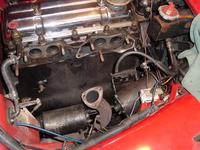
|

Triumph/TR3A Projects:Generator to Alternator Conversion
|
|
I spent ages trying to find a way to replace my generator with an
alternator. Many had suggested the workhorse Delco 10SI or 12SI
series, they're cheap and easy to come by, but all the notes I
saw about them discussed engine mods, which I wasn't interested in.
(The Delco is also referred to as a 7127, this is the Lester part
number, not the Delco part number - it was used on
a plethora of GM vehicles, you can find it at Kragen, Napa, etc..
for around $50)
I bought a 10SI and it seemed like the alternator body was too wide
for me to be able to tighten the belt, and unfortunately most alternators
are the same 5.25" width. I discovered the CS-121/CS-131 which were
SI series replacements from GM.
(SI is for "systems integrated" due to the fact that
these were some of the first alternators to have an internal regulator,
and CS is for "charging systems").
The 121 and 131 were the width of the stator (alternator body) in mm,
making the CS-121 is about .5" thinner than the SI series alternators,
but I wasn't sure of how well it would mount, and the alternators
are harder to find since the few vehicles that used a CS-121 can take a
CS-131 as well, so the auto shops only stock the 131. I tracked one
down at an industrial alternator shop for around $200.
In the end, it didn't matter, because just as I was about to buy I
found a company that sells an alternator conversion kit. They use
a 10SI/12SI which has some simple case modifications (photos coming
soon), and it fits and works fine, cranking out over 90A. Because
of the high current (which would blow the ammeter), they recommend
wiring direct to the battery which means your ammeter will only
read discharge, but your charging light still works since it is on
the field circuit. And presuming the regulator works fine, you
can just look at the ammeter as a reading of how much power the car
is using. Since the conversion requires a negative ground, you need
to do the very simple ground conversion (see 2003/12/03 in the maintenance
history), and if you don't flip the ammeter nodes, then this will
just read positive anyways.
The shop I bought it from seems to have disappeared:
Power British
http://www.pond.com/~britcars/
Phone: 610-270-0505
I think the important part of the kit is a new belt, the proper pulley and
spacers to push the alternator forward.
For how to wire it up, you can take a look at:
Triumph Alternator Upgrade
Evidently you can also buy a similar (same) kit from
Triumph Rescue
|
|
|
|
|
|
|
|
|
|
|
|
|
The kit from Power British.
Includes a 3/4"x38-1/2" belt (19mm-980mm) - Specifically "Gates TR24379 Replaces (308) Green Stripe II"
|
This "U" mounting plate is removed
(but put the bolts back in so the engine doesn't leak (more) oil!)
|
Alternator mounted.
I had to pull the manifolds because I was replacing a head gasket, but I would recommend doing it anyways.
|
From the back
|
|
|
|
|
Showing the spacers on the adjustment arm.
I have since moved the alternator forward because it wasn't in line, and it was causing the belt to wear down and eventually broke the pulley. Hopefully I'll get some photos up soon, but you can eyeball it pretty easily, I'm surprised I didn't notice the misalignment when I first set it up (I think the directions were wrong on the conversion).
|
What happens to the engine pulley
if you don't space the alternator properly.
|
|
|
|
For fan belt replacements:
I first used Gates TR24379, but it's fairly short (3/4"x38.5"). I switched to Dayco 24380 which
gives slightly more length, but I'd like to get more space between the alternator and engine block.
The next Gates 3/4" belt is TR24400 which is 40 5/8" outer. If you drop down to 22/32" width, you can get a 39.75".
The Gates Green Stripe II belts are segmented/cogged, which gives flexibility which means less sideways pressure on the alternator, and
this is a good thing, as Triumph belts are often much tighter than they need to be, causing belt wear and alternator/generator bearing
wear, eventually causing a metallic whine (which can come from a worn belt!).
There are also belts by Dayco and goodyear, and often they have "interchange"/interchangeable part numbers where the actual length can
be off by a 1/2" or so (one belt is 38" inner diameter and one is 38" outer diameter). On the Triumph there is so little room for error
considering the amount of play you need to have, space you want between the alternator/generator and the engine due to heat issues, and the
lengthening of the belt over time. So a 38" outer diameter belt is just too small, but a 38" inner diameter can just barely work.
So I found a number of spec sheets for various belts. Often the part numbers are related to belt dimensions, but not always in
the same way and not always consistently. For Goodyear/Continental, the part number XXYYZ has XX as width in 1/32", YY as outside length and Z is supposedly 1/8" length.
Having said that, Goodyear claims that 24377 is 37.5", and 24393 is
39". So I'm not sure how they figure the fractional lengths. Maybe
this is effective length which is at the top of the cogs, but not the
outer diameter? Then for Dayco, the YYZ is *inner* length in decimal fractions: YY.Z" (rounded),
i.e.: 24398 is 39.75" inner (34.8 rounded, and with an outside diameter of 40.39" - too big).
Here is a table with the close candidates I have found, I make no guarantee as to the correctness of these measurements, they
are generally from the manufacturers, and it seems they aren't fully clear on their own specs.
| Mfr |
Part |
Width (top) |
Inner length |
Outer length |
Angle |
Notes (assuming alternator conversion) |
| Gates Green Stripe II (cog) |
TR24379 |
3/4" |
38" |
38.5" |
36° |
|
TR24400 |
3/4" |
40" |
40 5/8" |
36° |
Too long. |
|
TR22392 |
22/32" (.6875") |
39.25" |
39.75" |
36° |
Possibly too long? |
| Goodyear |
24377 |
3/4" |
37.5" "effective length"? |
|
Probably too short? |
|
24393 |
3/4" |
39" "effective length"? |
|
| Dayco ("Top Cog") |
24380 |
3/4" |
38" |
38.64" |
38° |
Currently using - short but workable |
|
24390 |
3/4" |
39" |
39.64" |
38° |
Possibly too long? |
|
24398 |
3/4" |
39.75" |
40.39" |
38° |
Too long. Verified measurements. |
|
22385 |
22/32" (.6875") |
38.5" |
39.15" |
|
| Dayton (Grainger) |
6A155 (B belt) |
21/32" (.656") |
|
39" |
|
13/32" thickness? |
|
6A123 (BX belt) |
21/32" (.656") |
|
39" |
|
13/32" thickness? Cogged belt |
|
5L390 (5L belt) |
21/32" (.656") |
|
39" |
|
3/8" thickness. More for lawnmowers than automotive |
Other alternator conversion methods:
- Delco 10Si with a wide pulley from an agricultural machine supplier
(suggested trimming of mounting to get alignment right)
- Nippon-Denso 27029-61011
- Moss motors has a full kit (including mounting arm/hardware) for $320
Some notes about the pulley:
- Go down to your local alternator rebuild shop and ask
for either part number 1214P or 201-01005. - John Kallaus
- FWIW, I found a source for the wide pulley for my ongoing conversion to a
Delco alternator. The vendor is Quick Start Electric Products
(http://www.alternatorparts.com/Alternator_brackets_2.htm) - Dean Mericas
- I just bought a 2-1/2" pulley that fits a GM or Fiesta Alternator from a
place in Wichita KS. (Phone # 316-265-8990) It is made for the wide belt. -
Kent Schrack
Alternator Sourcing
10SI/12SI part numbers
(Triumph conversion works best with a 3 or 12 o'clock mounting)
It's easy to change the mounting - pull out the 4 bolts holding the
two halves together, but do not pull the two halves apart. If you
separate them by more than a 1/4" or so, you will pop out the bushings
and they are hard to get back in. Instead just rotate the halves and
bolt them back together.
| SI Series |
Amp rating |
clocking |
Lester # |
Delco # |
Vehicle |
| 10 |
63 |
3 |
7127
7127-3 |
321-143
321-39*
334-2112? |
1978 Cultlass Supreme, 260 V8
1984 Chevy Camaro, 305 V8,4BBL *or* 1978 Camaro 350 v8 w/ air |
| 10 |
63 |
6 |
7127-6 |
321-135 |
(possibly not used??) |
| 10 |
63 |
9 |
7127-9 |
321-41 |
1979 Buick Regal, 8cyl 4.9L (301W) engine w/ air |
| 10 |
63 |
12 |
7127-12 |
321-43
334-2115? |
1977 Pontiac Grand Prix, 8cyl 5.7L (350R) w/ air *and with HBL* (rear defrost) |
| 12 |
78 |
3 |
7273-3?
7278-3 |
321-247
321-357 |
1985 Buick Century Custom, V6
1986 Buick Regal 307 V8 *or* 1985 Pontiac Firebird 5.0L (305H) V8, no air, HBL (rear defrost) |
| 12 |
78 |
6 |
7278-6 |
??? |
(possibly not used??) |
| 12 |
78 |
9 |
7278-9 |
321-244 |
1985 Oldsmobile cutlass Suprime, 5.0L (307Y) V8 |
| 12 |
78 |
12 |
7278-12 |
321-249 or 321-254 |
1983-1986 Buick Skyhawk, 1983-1986 Chevy Cavalier
1986 Pontiac Sunbird, 1984-1986 Cadillac Cimarron |
| 12 |
94 |
3 |
7294-3 |
321-266 |
1984 Chevy Camaro 305 V8 |
| 12 |
94 |
6 |
7294-6 |
321-269 |
| 12 |
94 |
9 |
7294-9 |
321-269 |
1985 Buick Riviera, 5.0L (307Y) V8 with air |
| 12 |
94 |
12 |
7294-12 |
??? |
|
12SI alternators were built with 56amp, 66amp, 78amp, and 94amp maximum output ratings.
12SI has (better) plastic instead of metal fan and a ridge on the front of the alternator + fan
to ensure that air must come through the alternator body.
12 o'clock mounting puts the electrical connector up against the engine and is unlikely to be found.
|
|
|
|
|